
Write the Relationship as a Sentence First.
Before drawing a line, say what it means. “This profile links to this storefront” tells a reviewer more than “connected.” “This captured page displays this email” states an observation they can check. Clear language also helps you notice when you are joining two things on an assumption.
Start with the few items needed to explain the question: a site, an account, an identifier, and the relevant sources. Keep the account’s displayed name separate from a claim about the person operating it. Similar names, images, or contact details may justify further work without establishing identity.
Give Observation and Inference Their Own Wording.
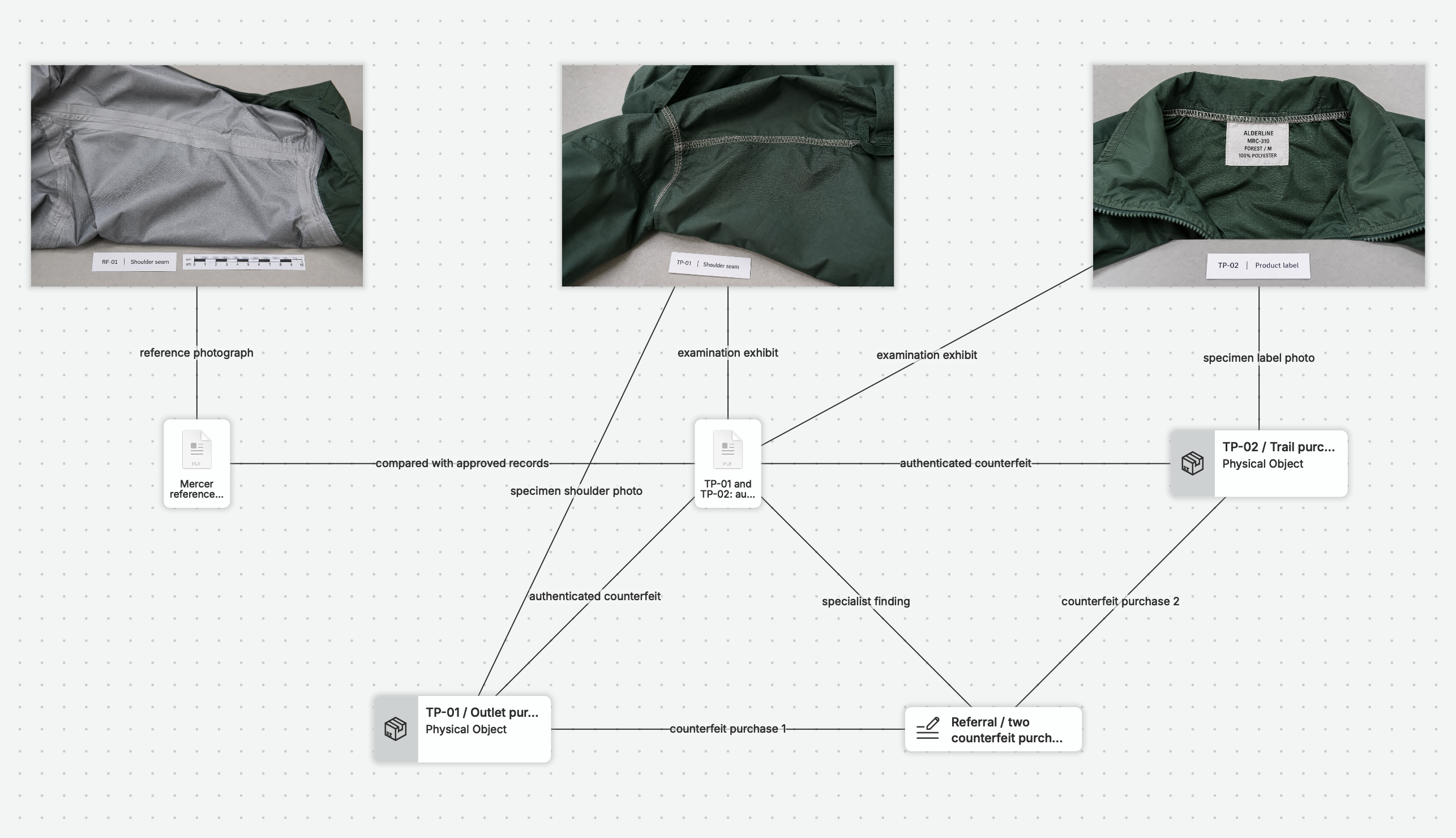
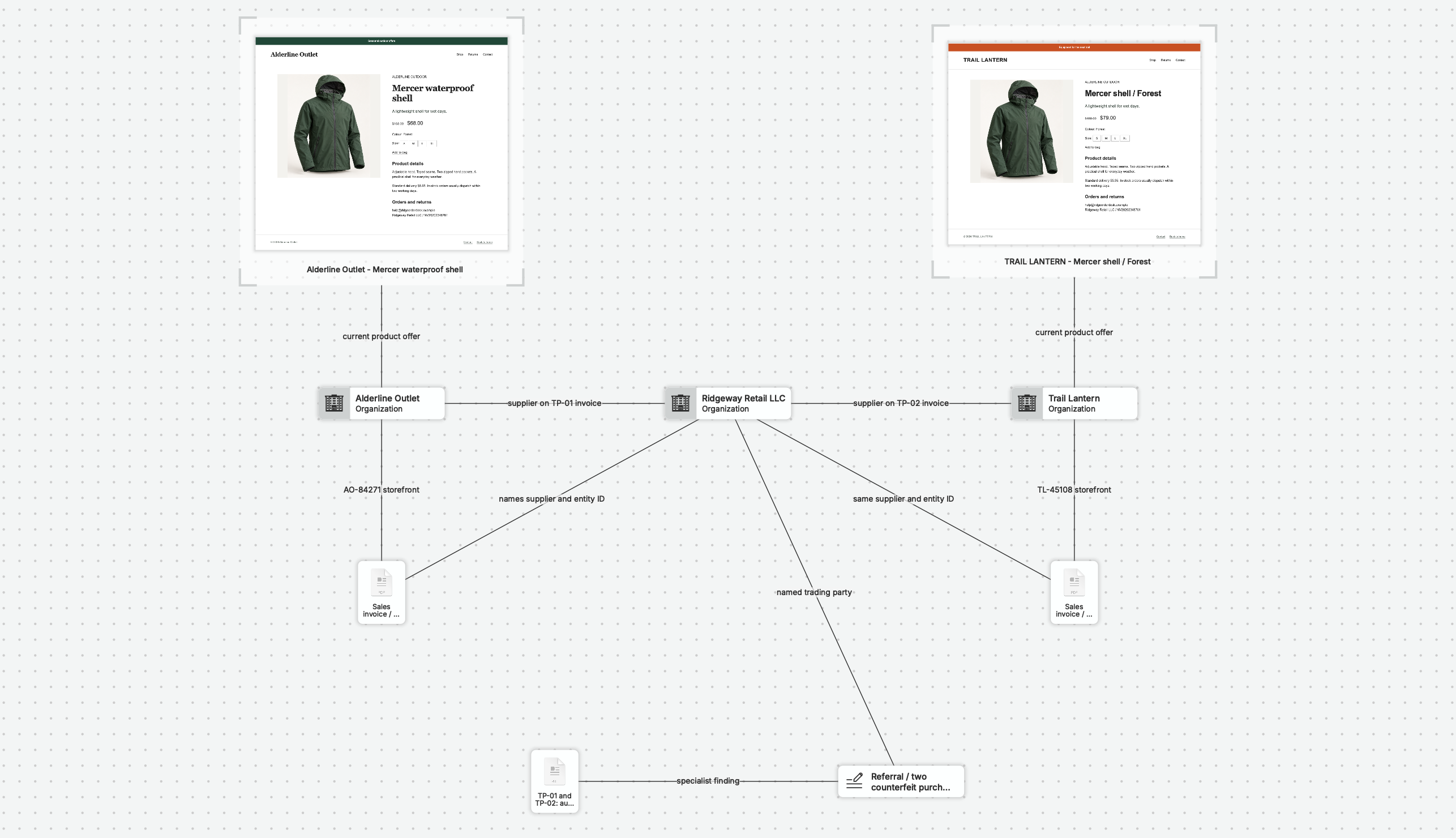
In the storefront example, recorded observations help decide which properties to carry into the next research pass. Keep each observation and the resulting research decision distinct so a reviewer can inspect the reasoning.
| Statement | What Supports It | What Remains Open |
|---|---|---|
| TP-01 was purchased from Alderline Outlet. | The purchase log, AO-84271 invoice, parcel reference, and separate custody record. | Who supplied the seller with that garment. |
| Both purchase invoices name Ridgeway Retail LLC. | Invoices RWR-260819-4271 and RWR-260820-5108 show the same entity number. | The named supplier’s upstream source and knowledge. |
| The parcels and Summit return share a returns address. | Parcel-label records, warranty paperwork, and Baybridge’s service reply. | Which merchants use the service and whether the address says anything about the goods. |
| Exclude Summit Yard from the counterfeit referral on the examined evidence. | The product specialist authenticates WR-03 as genuine. The brand’s distribution records corroborate Summit’s previous-season stock invoice. | The shared returns centre explains an address overlap; it does not override the specimen examination. |
Build the Connection Around Its Support.
Identify the Items Consistently
Use names that distinguish the site, profile, and source. Retain the exact identifier in the relevant material or entity data. Keep similar-looking accounts separate while you investigate whether they are actually the same.
Connect the Relevant Case Items
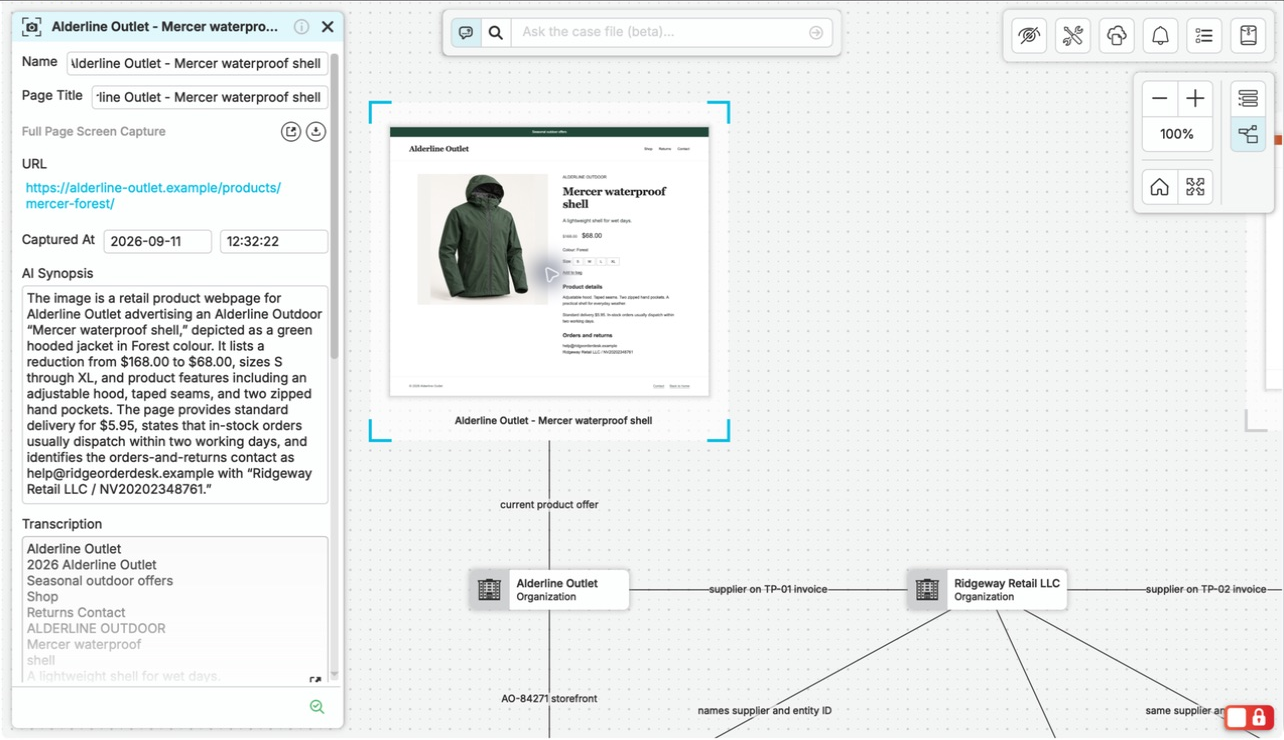
nQuest links join two case items, and relation blocks describe specific relationships on that link. Use a relation whose wording matches what you can establish. Read its direction aloud to check that the statement means what you intended.
Keep the Source Within Reach
Connect the relevant capture and add an explanatory note where it helps. Include the observation, the collection context, and any limits. A reviewer should be able to find the material that led you to record the relationship.
Record the Unresolved Alternative
Write down another plausible explanation and the next check that could distinguish it. For a repeated contact detail, ask whether it was independently published or simply copied from another page.
Explain Confidence in Words.
Where uncertainty is enabled in the library, nQuest relation blocks can carry an investigator-entered certainty value. Use it consistently with your team’s method and keep the reasoning in the case. The number represents your assessment; it is not a measured probability or independent verification.
Even a firmly observed relationship needs careful scope. You can be confident that a captured page displays a particular email while remaining uncertain about the email’s owner. Record those as different claims so confidence in the observation does not silently become confidence in attribution.
Check the Connection from the Reader’s Side.
Return to the case as if you had not built it. Can you read the relationship, locate its support, and identify the unresolved question? Use the graph to inspect the connection and the list view to review the relevant material systematically.
Also record why an apparent connection does not support your finding. In the Alderline example, Summit Yard shares a returns centre with the parcels under review. A genuine garment examination, corroborated stock records, and the provider’s shared-service explanation keep it outside the counterfeit referral. Preserve those reasons so the next reviewer can assess the exclusion.
Questions Worth Asking.
Does every item need a connection?
No. A simple nQuest case can be a collection of items. Add relationships when they help explain a meaningful observation or hypothesis; you can build the structure as the work develops.
Can two items have more than one relationship?
Yes. nQuest uses one link between two items, with multiple relation blocks when needed. Each block should express a distinct relationship clearly enough for a reviewer to interpret.