
Bring Several Sources into One Question.
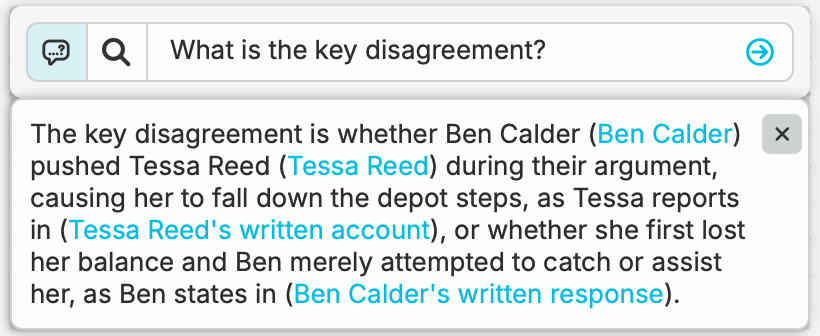
In the Westbridge case, Tessa says her supervisor pushed her; Ben says he tried to catch her. Leah brings their accounts, the incident entry and Tessa’s hospital document into nQuest.
Ask a question in plain language. nQuest draws on the case material and links its answer to the source records.
Follow the Answer into the Record.
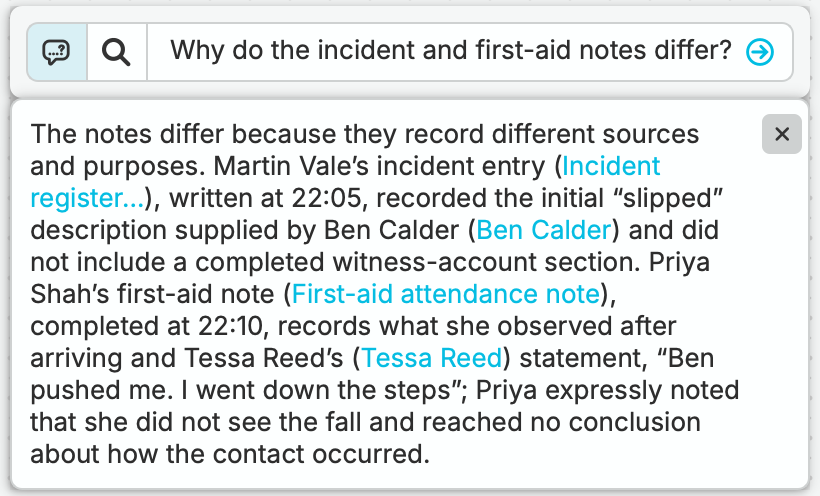
Read the answer for the support it gives each explanation, then open the referenced records. An incident form may look authoritative, but Leah needs to know where its description of a slip came from.
Open the Supporting Item
Follow a case reference to the passage, image, or field behind the statement. Use case search to find additional material relevant to the same question.
Read the Surrounding Context
Check who is making the statement, what page it appears on, and which date it concerns. A quoted claim, a historical reference, and a current contact detail can contain the same words but mean different things.
Check Whether the Accounts Are Independent
The duty manager arrived after the fall and used Ben’s description in the incident entry. The first-aid note, obtained later, records Tessa’s allegation. Neither responder witnessed the contact. Check whether an answer has counted a repeated account as another eyewitness.
Test the Competing Sequence
Leah interviews Amir Cole, a technician who saw the contact from the doorway. She asks him to describe the movement he observed, checks his opportunity to see it, and puts his account to Ben. The question is whether contact preceded the loss of balance or was an attempt to respond to it.
Turn Uncertainty into the Next Research Question.
An unanswered detail gives the next inquiry a focus. Search the case for relevant material, identify which source could clarify the point, and record the follow-up as a task. Bring the new material into nQuest as the investigation develops.
Distinguish “I found no supporting material in this case” from “this did not happen.” A negative conclusion needs a scope: which sources you reviewed and what they could reasonably establish. The absence of a detail from your collection is a limit to record.
Write the Conclusion in Your Own Terms.
Add a note with your conclusion, the supporting case items, and the next step. Explain how the follow-up changed your understanding, keeping the original accounts, later records, and responses together for your reviewer.
Questions Worth Asking.
What should I check in a referenced source?
Read the original wording, its context, and the date it concerns. Check each material statement in the answer, including any without a reference, and record the conclusion your review supports.
How is case material processed by AI?
nQuest uses cloud services and external inference providers for product AI processing. The AI and data page explains content analysis, case questions, and summaries, with contact details for your organization’s processing requirements.